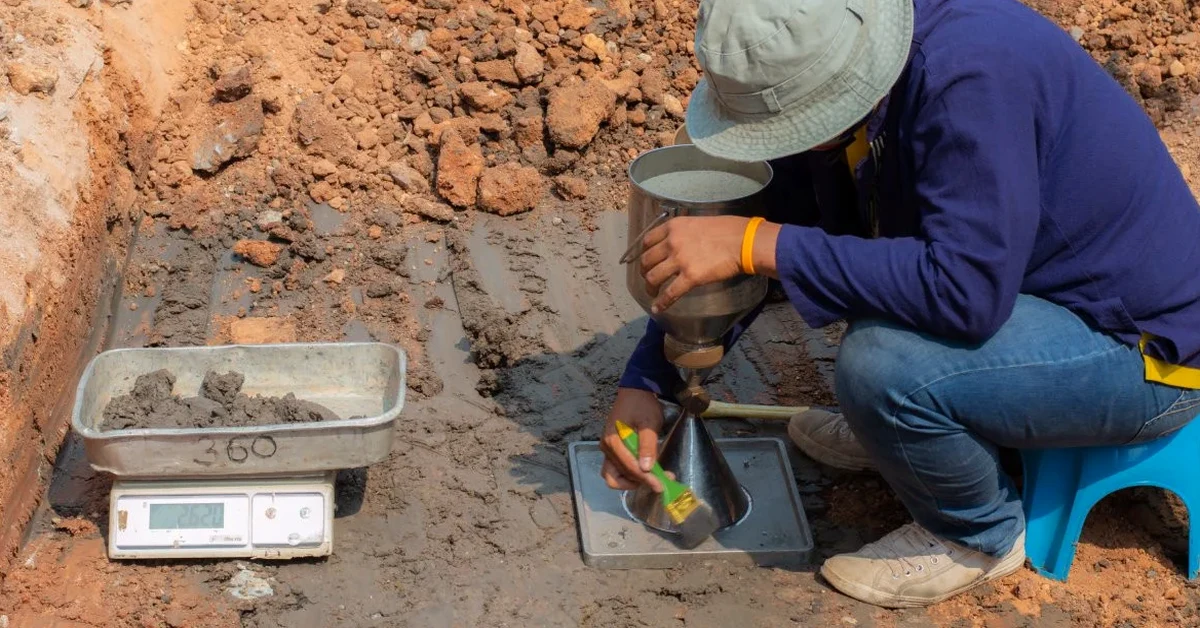
AS 1726:2017 sets the framework for subsurface investigation in Australia, and for Brisbane that standard takes on extra weight because the city's geological profile includes alluvial sands, residual granitic soils, and old floodplain deposits that can exhibit sudden collapse upon wetting. A collapsible soil evaluation in Brisbane is not a routine soil test — it is a targeted assessment of metastable structures that may lose volume when saturated under load. The team begins with undisturbed tube sampling and then runs oedometer tests at controlled moisture contents to identify the collapse potential index. Complementing that analysis with a plate load test on site provides a direct measure of bearing behaviour under simulated wetting, which is critical for shallow foundation design in areas like the Brisbane River corridor.
A dry soil profile can show acceptable bearing capacity, yet lose half its strength within hours of wetting — collapsible soil evaluation catches that hidden risk.
Scope of work
A common mistake made by developers in Brisbane is to rely solely on standard penetration test (SPT) N-values to assess foundation conditions, ignoring the fact that collapsible soils can show acceptable resistance when dry but lose 40 to 60 percent of their bearing capacity once water enters the profile. The evaluation methodology therefore follows a multi-stage protocol:
Undisturbed sampling using thin-walled Shelby tubes to preserve the natural fabric
Double-oedometer testing per AS 1289.6.7.2 to quantify collapse strain at in-situ and saturated conditions
Field density and moisture profiling to map depth of metastable layers
Without these steps the design remains blind to the sudden settlement that can occur after a heavy rain event or a broken water main. A proper collapsible soil evaluation in Brisbane also includes a review of local rainfall intensity data and historical groundwater fluctuations, both of which influence the collapse trigger threshold.
Technical reference image — Brisbane
Area-specific notes
Compare a site in the inner-northern suburb of Albion, where residual schist and phyllite dominate, with a lot in the low-lying corridor of Rocklea near the Brisbane River floodplain. In Albion the collapsible potential is typically low because the soil structure is more cemented, whereas in Rocklea the alluvial silty sands can exhibit collapse strains above 4% when soaked. That difference means two identical house designs can perform very differently. A collapsible soil evaluation in Brisbane must account for these intra-city variations; assuming uniform behaviour across suburbs leads to differential settlement that cracks slabs, jams doors, and damages underground services within the first wet season.
Double-oedometer and single-oedometer tests per AS 1289.6.7.2 to determine collapse strain at multiple stress levels. Results include the collapse potential index and a collapse-settlement curve for foundation design.
02
Undisturbed Field Sampling
Thin-walled Shelby tube sampling with careful handling to preserve natural moisture and fabric. Depth and spacing follow AS 1726 requirements, with samples sealed and transported to the lab within 24 hours.
03
In-Situ Moisture & Density Profiling
Sand replacement and nuclear density gauge measurements at 0.5 m intervals to map the vertical variability of moisture and dry density, identifying the depth of metastable layers most vulnerable to collapse.
This service complements our laboratory testing work for a complete project analysis.
Standards used
AS 1726:2017 – Geotechnical site investigations, AS 1289.6.7.2 – Soil consolidation and collapse testing, AS 1289.7.1 – Standard test method for collapse potential of soils
Frequently asked questions
How much does a collapsible soil evaluation cost in Brisbane?
The typical range for a complete collapsible soil evaluation including sampling, oedometer testing, and reporting is between AU$1,220 and AU$3,700. Final cost depends on the number of test depths, site access conditions, and whether additional field work such as plate load tests is required.
Which Brisbane suburbs are most likely to have collapsible soils?
Low-lying suburbs along the Brisbane River floodplain such as Rocklea, Yeronga, and Fairfield show higher collapsible potential due to alluvial silty sands. Areas with residual granitic soils like The Gap and Kenmore can also exhibit metastable structures, though typically at lower collapse strains. A targeted evaluation is the only way to confirm site-specific risk.
How does collapsible soil evaluation differ from a standard soil test?
A standard soil test focuses on bearing capacity and classification, while a collapsible evaluation specifically measures the volumetric response of the soil when wetted under load. It requires undisturbed sampling, double-oedometer testing at controlled saturation, and a collapse potential index calculation — none of which are part of a routine classification test.
Can collapsible soils in Brisbane be treated or improved?
Yes, options include dynamic compaction, pre-wetting with controlled flooding, chemical stabilisation using lime or cement, and excavation and replacement of the metastable layer. The choice depends on the depth and thickness of the collapsible zone, the collapse strain magnitude, and the project budget. The evaluation results directly guide the selection of the most cost-effective treatment.