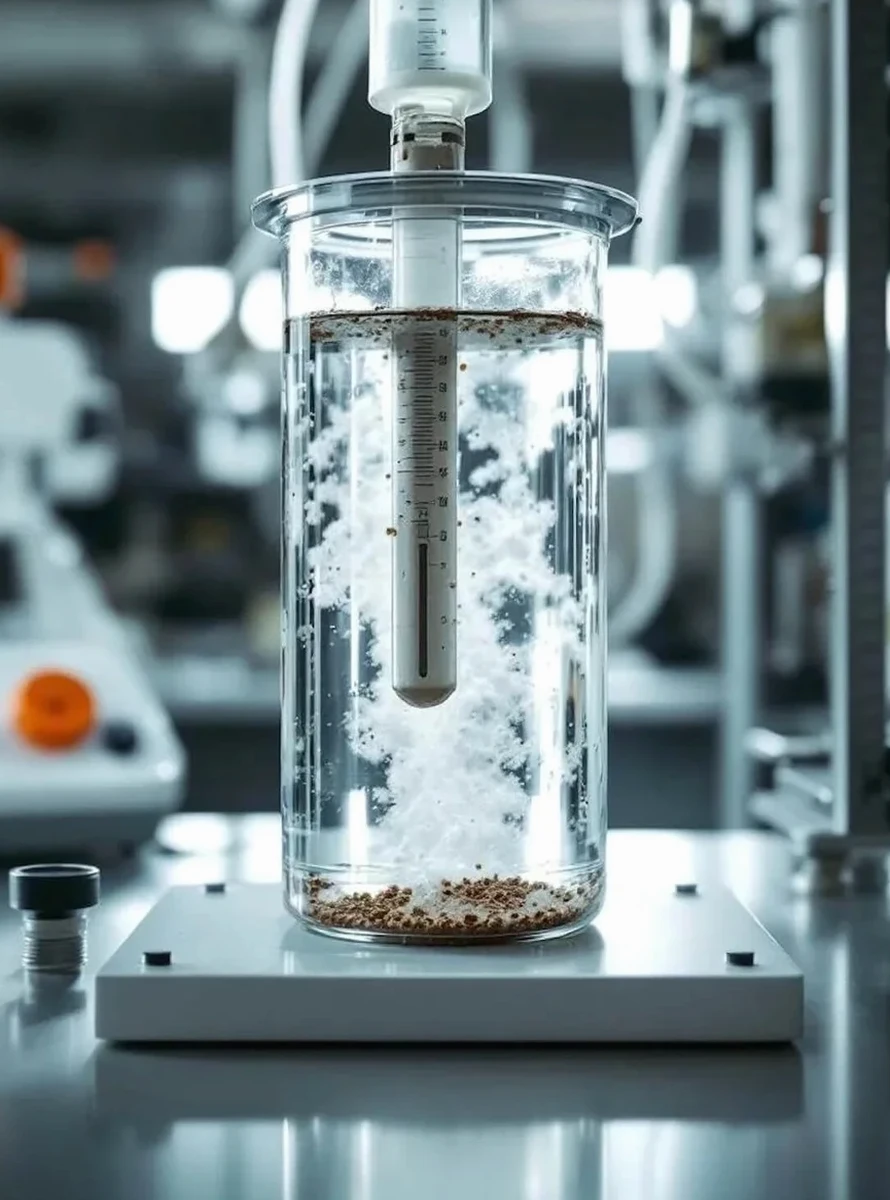
Brisbane's geotechnical work follows AS 1289.3.6.1 for particle size distribution, and our grain size analysis in Brisbane applies that standard to every sample. The city's geology spans weathered phyllite in the inner suburbs to deep alluvial clays along the Brisbane River floodplain. A complete sieve and hydrometer test tells us exactly how much sand, silt, and clay is present. That split controls everything from pavement design to foundation bearing capacity. Before we interpret compaction curves or run a consolidation test, we need the gradation curve right. It is the starting point for classifying soil under the Unified Soil Classification System (USCS) and for predicting drainage behaviour on any site here.
One continuous gradation curve — from 75 mm cobbles down to 0.5-micron clay — is what separates a reliable classification from a guess.
Scope of work
Brisbane grew fast through the 1980s and 1990s, pushing development onto former floodplains like Eight Mile Plains and into the steep residual soils of the western suburbs. That expansion made grain size analysis in Brisbane a routine requirement for subdivision earthworks and slab-on-ground construction. The method itself is straightforward but demanding: we oven-dry the sample, wash it through a 75-micron sieve, then stack the sieves from coarse to fine for the mechanical shake. For the material passing 75 microns, the hydrometer reads settling velocity over 24 hours to resolve silt from clay fractions. We combine both curves into one continuous gradation report. On sites with suspected collapsible soils, such as some areas near Wacol, we pair this test with a sieve analysis for the coarse fraction and then check atterberg limits to confirm plasticity. The whole sequence gives the design team the full particle-size picture before any structural fill is placed.
Technical reference image — Brisbane
Area-specific notes
In Brisbane, we often see imported fill from quarry sources that looks clean but contains a high fines content. If that material goes straight into a road subgrade without a grain size analysis in Brisbane, the clay fraction can cause differential heave under wet conditions. Another common issue is misclassifying a silty sand as a well-graded sand because the hydrometer step was skipped. That mistake leads to overestimating drainage capacity and undersizing the pavement thickness. We also find that the alluvial clays near the river, especially around New Farm and West End, have a plastic fines content that only shows up when the full hydrometer curve is done. Skipping it means the plasticity index gets calculated on an incomplete sample. For sites where the water table is high, we recommend combining the gradation with a permeability test in the lab to cross-check the estimated flow behaviour.
75 mm, 37.5 mm, 19 mm, 9.5 mm, 4.75 mm, 2.36 mm, 1.18 mm, 600 µm, 300 µm, 150 µm, 75 µm
Hydrometer range
75 µm down to 0.5 µm (clay fraction)
Sample mass required
200 g (fine) to 5 kg (coarse)
Wash loss (%)
Reported as passing 75 µm (silt + clay)
Dispersion agent
Sodium hexametaphosphate (Calgon) at 40 g/L
Test duration
Mechanical sieving ≈ 15 min; hydrometer readings over 24 h
Reporting standard
AS 1289.3.6.1 – particle size distribution
Linked services
01
Standard Sieve Analysis (Coarse Fraction)
Dry sieving from 75 mm down to 75 µm for gravels and sands. Used for road subbase, pipe bedding, and general fill classification. Typical turnaround is 24 hours.
02
Combined Sieve & Hydrometer (Full Gradation)
Complete particle size distribution from 75 mm cobbles down to 0.5 µm clay. Includes wash loss determination and dispersion correction. Essential for earthworks specifications, embankment design, and pavement subgrade evaluation.
03
Hydrometer-Only Analysis (Fine Fraction)
Focused on the silt and clay fraction passing 75 µm. Used when the coarse fraction is already known or when assessing dispersive soils. Includes sedimentation readings at 0.5, 1, 2, 4, 8, 15, 30, 60, 120, 240, and 1440 minutes.
Standards used
AS 1289.3.6.1 – Particle size distribution (sieve + hydrometer), AS 1289.3.6.3 – Fine-grained soils (hydrometer), AS 1289.3.6.1 – Standard test method for particle-size analysis (reference)
Frequently asked questions
What is the difference between dry sieving and wet sieving in grain size analysis?
Dry sieving is used for clean sands and gravels where fines are minimal. Wet sieving washes the sample through a 75-micron sieve to remove clay and silt coatings, giving an accurate mass of fines. In Brisbane's residual soils, which often have clay coatings on sand particles, wet sieving is the standard method per AS 1289.3.6.1.
How much does a full grain size analysis (sieve + hydrometer) cost in Brisbane?
For a combined sieve and hydrometer test with a full report, the typical cost ranges between AU$150 and AU$330 per sample, depending on the number of sieve sizes and whether a hydrometer curve is required. Volume discounts apply for projects with 10 or more samples.
Why is the hydrometer test necessary for soils in Brisbane's floodplain areas?
The alluvial clays along the Brisbane River and creeks like Enoggera Creek have a significant clay fraction below 2 microns. The hydrometer detects that fraction precisely. Without it, a silty clay can be misclassified as a silt, leading to incorrect estimates of shrink-swell potential and drainage behaviour. This is critical for slab-on-ground design in suburbs like Milton and Toowong.