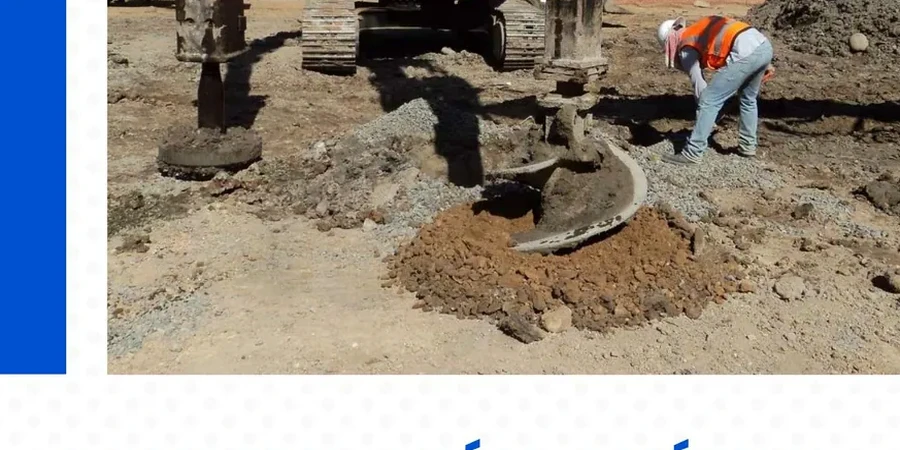
Ground improvement in Brisbane represents a specialised branch of geotechnical engineering focused on modifying the physical properties of soil and rock to meet the demands of modern construction. The city's subtropical climate and complex geological history mean that natural ground conditions are rarely ideal for infrastructure, residential subdivisions, or commercial developments. From the reactive clays of the western corridors to the soft alluvial deposits along the Brisbane River, engineers must routinely enhance bearing capacity, control settlement, and mitigate liquefaction risks. Stone column design and Lime and cement stabilization are among the most deployed techniques, offering reliable pathways to transform marginal sites into buildable land. Without these interventions, many of the region's landmark projects would face unacceptable long-term performance issues or prohibitive excavation and replacement costs.
Brisbane's geology is dominated by the Brisbane Tuff, a welded ignimbrite that provides excellent foundation conditions where it lies near the surface, yet much of the city's urban growth occurs on the floodplains of the Brisbane and Logan Rivers. These areas are underlain by Holocene alluvium—soft silts, organic clays, and loose sands that can extend to depths exceeding 30 metres. The presence of acid sulfate soils in low-lying coastal zones adds another layer of complexity, requiring careful management during any ground treatment. Organic soil management becomes critical in these environments, as decomposition of peat and organic silts can trigger differential settlement that damages pavements and buried utilities. Understanding the interplay between the residual soils derived from Neranleigh-Fernvale Beds metasediments and the transported Quaternary sediments is fundamental to selecting an appropriate improvement strategy.
The regulatory framework governing ground improvement in Australia is robust, with AS 4678-2002 (Earth-retaining structures) and AS 5100.3-2017 (Bridge design – Foundations and soil-supporting structures) providing mandatory design parameters. Queensland's Department of Transport and Main Roads (TMR) supplements these with Technical Specification MRTS04 (General Earthworks) and MRTS70 (Soil Treatment), which prescribe minimum acceptance criteria for treated ground. For projects involving deep mixing or grouting, compliance with AS 3798-2007 (Guidelines on earthworks for commercial and residential developments) ensures that verification testing—such as plate load tests, cone penetration tests, and cross-hole seismic surveys—meets the expectations of certifying geotechnical engineers. Grouting design must also align with the environmental protections outlined in the Environmental Protection Act 1994 (Qld), particularly when chemical admixtures could interact with groundwater systems.
Typical projects that demand ground improvement range from transport infrastructure—where embankments over soft ground require Preloading design to accelerate consolidation without the expense of surcharge—to industrial warehousing on former floodplain sites. Residential estates in areas like Ripley and Flagstone frequently employ lime stabilisation to tame expansive clays, while high-rise developments along the Brisbane River often integrate Geotechnical instrumentation to monitor pore water pressure dissipation during staged loading. Landfill capping and containment facilities rely on precise Geomembrane specification to isolate treated ground from leachate, ensuring long-term environmental compliance. Each project type demands a tailored combination of investigation, design, and verification that reflects Brisbane's unique geotechnical challenges.
Lime and cement stabilisation is the preferred approach for Brisbane's expansive clays, which are common in western suburbs. Lime modifies the clay mineralogy through cation exchange, reducing plasticity and swelling potential, while cement provides strength gain. Deep soil mixing can extend treatment to depths beyond conventional ripping, ensuring uniform improvement across the entire building platform.
Soft alluvial soils are typically treated using stone columns, which provide vertical drainage and reinforce the ground through aggregate compaction. This accelerates consolidation settlement and increases bearing capacity. Preloading with or without surcharge may be combined with stone columns to achieve target settlement within program constraints, especially for embankment construction.
Key standards include AS 4678 for earth-retaining structures, AS 3798 for general earthworks, and AS 5100.3 for bridge foundations. Queensland TMR supplements these with MRTS70 for soil treatment and MRTS04 for general earthworks. Verification typically requires in-situ testing such as cone penetration tests, plate load tests, and geophysical surveys to demonstrate compliance.
Ground improvement is often selected when treating large areas where deep foundations would be uneconomical, such as residential subdivisions, warehouse slabs, or embankments. It is also preferred when the improved ground can serve as both a foundation and a working platform, or when excavation and replacement is impractical due to depth or environmental constraints like acid sulfate soils.