Many builders in Brisbane assume a standard soil test is enough, skipping the SPT entirely. That mistake often leads to underestimating bearing capacity on the city's variable alluvial deposits and residual soils. Without the Standard Penetration Test, you get no direct measure of soil resistance at depth, and foundation designs rely on guesswork. SPT is the only in-situ method that gives both a soil sample and a penetration resistance value in a single operation, making it essential for residential slabs and commercial piles alike. Before pouring concrete, confirm conditions with an SPT program tailored to your site.
SPT remains the most widely accepted in-situ test for foundation design in Australia, with direct correlations to bearing capacity and liquefaction potential.
Scope of work
In Brisbane, we see many engineers request SPT exclusively for cohesionless soils, but the test also provides useful data in stiff clays and weathered rock. The procedure follows a strict 63.5 kg hammer drop, driving a 50 mm split-spoon sampler 450 mm, with N-value recorded over the final 300 mm. We log blow counts per 150 mm increment and extract disturbed samples for classification. For deeper profiling, we combine the SPT with CPT testing where continuous stratigraphic detail is needed. The test also pairs well with geotechnical site investigation for comprehensive soil characterization under AS 1726.
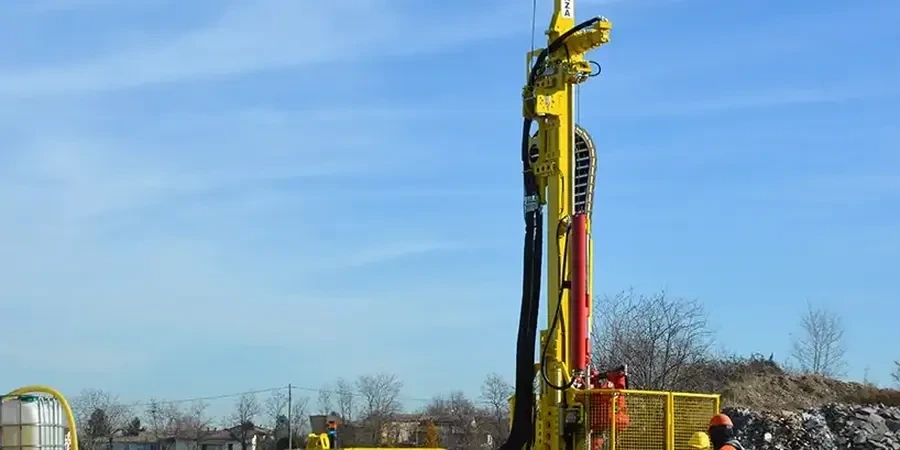
Technical reference image — Brisbane
Area-specific notes
Brisbane's geology is dominated by the Neranleigh-Fernvale beds and Quaternary alluvium along the river. The water table sits shallow in low-lying suburbs like Albion and Newstead, often at 2–4 m depth. In these conditions, an SPT without proper casing can collapse the hole before reaching target depth. We use mud rotary drilling to stabilize the borehole and prevent washout of fine sands. Ignoring the SPT in these saturated zones means missing the risk of liquefaction during a seismic event. The NCEER method (Youd & Idriss 2001) requires corrected N-values to assess cyclic resistance, and we deliver those corrections.
Boreholes to 15 m depth with SPT every 1.5 m, log N-values, retrieve samples for classification. Includes water table observation and basic soil description per AS 1726. Suitable for slab-on-grade or shallow footing designs in Brisbane suburbs.
02
Advanced SPT with Seismic Corrections & Liquefaction Assessment
Extended boreholes to 30 m, SPT at 1.0 m intervals in critical zones, energy measurement for N60 correction, fines content adjustment, and liquefaction triggering analysis. Delivers final report with N-SPT profiles, corrected N1(60) values, and factor of safety against liquefaction. Used for multi-storey buildings and bridge foundations.
Standards used
AS 1726:2017 Geotechnical Site Investigations, AS 1289.6.3.1 Standard Test Method for SPT, AASHTO T-206 Penetration Test and Split-Barrel Sampling
Frequently asked questions
What is the difference between N-SPT and bearing capacity?
N-SPT is the raw blow count from the test. Bearing capacity is derived from N-values using empirical correlations published in AS 1726 and geotechnical literature (e.g., Terzaghi, Meyerhof). The SPT provides the input; bearing capacity is the calculated output after correction for overburden, energy ratio, and fines content.
How much does an SPT test cost in Brisbane?
A typical SPT program with boreholes to 10 m depth and testing every 1.5 m ranges between AU$960 and AU$1.280 per borehole, depending on access, number of tests, and mobilization distance. Volume discounts apply for multiple boreholes on the same site.
What zones in Brisbane have the highest N-values?
The Neranleigh-Fernvale bedrock in suburbs like Indooroopilly and Toowong can yield N-values above 50 in weathered rock. Conversely, the alluvial sands and soft clays of the Brisbane River floodplain (e.g., Milton, South Brisbane) often return N-values below 10. Site-specific testing is essential.
When should I request SPT instead of CPT?
Request SPT when you need a direct soil sample for classification, or when you are working in gravelly soils where CPT cone refusal is common. SPT is also preferred for liquefaction assessment in sands because the N-value correction methods are well-established. CPT gives continuous profiles but no sample.