In Brisbane, the combination of reactive clay soils and a high water table means that rigid pavement design demands a thorough understanding of subgrade variability. Many project teams discover too late that standard CBR values from desktop studies don't reflect the actual conditions under a 300 mm concrete slab. That's why we always start with a targeted investigation that includes a plate load test on the formation level to confirm the modulus of subgrade reaction (k-value) before finalising the slab thickness. Without this data, even a well-designed joint layout can crack within the first year.
Without a site-specific k-value, even a well-designed joint layout can crack within the first year in Brisbane's reactive soils.
Scope of work
Our approach to rigid pavement design in Brisbane relies on a site-specific assessment of the subgrade, the concrete mix, and the expected traffic loading. We use a falling weight deflectometer (FWD) to measure the existing pavement's structural capacity and the subgrade's elastic modulus directly in the field. This data feeds into a finite-element model that accounts for temperature gradients and moisture variation, which are critical in subtropical climates. The process includes:
Subgrade sampling and laboratory classification (Atterberg limits, linear shrinkage, soaked CBR)
Determination of the design k-value using plate load tests or correlation with CBR
Traffic analysis and load repetition calculation per Austroads Pavement Design Guide
Joint layout and dowel bar design to control curling and faulting
All work follows AS 1726 and the Austroads Guide to Pavement Technology.
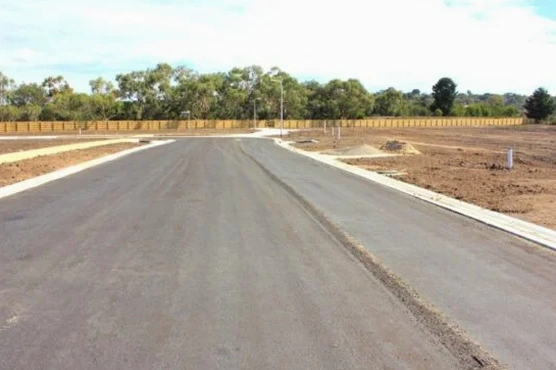
Technical reference image — Brisbane
Area-specific notes
One of the biggest risks in rigid pavement design for Brisbane is ignoring the shrink-swell behaviour of the local clays, particularly in suburbs like Carindale or Mount Gravatt where the clay profile can be 5 metres deep. When the subgrade dries out, it shrinks and leaves a void under the slab; when it wets up, it heaves and lifts the slab. This cyclic movement can cause corner breaks and pumping at joints. We mitigate this by designing a granular sub-base layer that acts as a moisture barrier and by specifying a minimum slab thickness that can bridge moderate gaps.
In-situ and laboratory CBR tests, including soaked CBR for worst-case moisture conditions, plus Atterberg limits and linear shrinkage to classify the soil's reactivity.
02
Pavement Structural Design and Modelling
Finite-element analysis using the design k-value and traffic loading to determine slab thickness, joint layout, and dowel bar requirements for rigid pavements.
03
Construction Phase Support and Quality Control
Plate load tests on the formation level, concrete cylinder testing, and joint installation inspection to ensure the design is correctly implemented in the field.
This service complements our laboratory testing work for a complete project analysis.
Standards used
AS 1726 – Geotechnical Site Investigations, AS 4678 – Earth Retaining Structures, Austroads Guide to Pavement Technology Part 2: Pavement Structural Design
Frequently asked questions
What is the typical cost for a rigid pavement design study in Brisbane?
The cost ranges between AU$3,300 and AU$10,990 depending on the project size, the number of test pits or boreholes, and the complexity of the traffic analysis. A small residential driveway would be at the lower end, while a major industrial yard with heavy truck loading would be at the higher end.
How long does a rigid pavement design take in Brisbane?
A typical residential or light-commercial rigid pavement design takes 3 to 5 working days from the completion of site testing. Larger projects with multiple pavement sections or complex traffic patterns can take 2 to 3 weeks.
What is the difference between rigid and flexible pavement design?
Rigid pavement uses a concrete slab that distributes loads through flexural strength, while flexible pavement uses a layered asphalt system that transfers load through aggregate interlock. Rigid pavement is better suited for areas with heavy static loads or where subgrade strength is variable, which is common in Brisbane.
Do I need a rigid pavement design for a residential driveway in Brisbane?
Yes, if you are pouring a concrete driveway on reactive clay, a rigid pavement design ensures the slab thickness and joint layout can handle shrinkage and heave. Without it, you risk cracking and uneven settlement within the first 12 months.