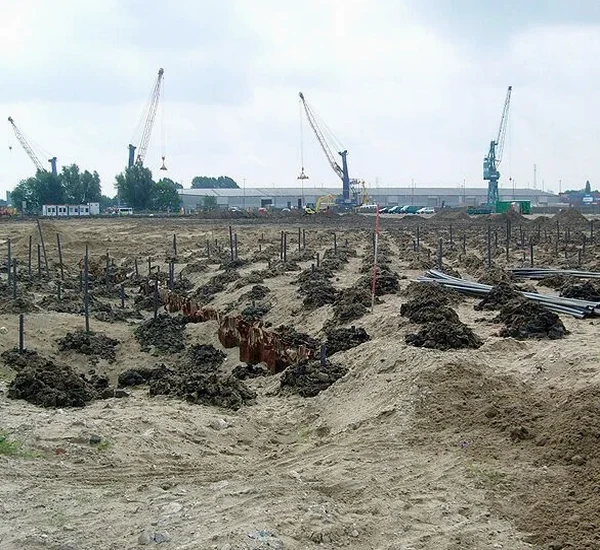
Brisbane's subtropical climate, with intense summer storms and high humidity, drives deep weathering profiles that complicate road construction. The underlying Brisbane Tuff and Neranleigh-Fernvale beds often produce variable residual soils, where moisture-sensitive clays alternate with competent rock bands. For any pavement project, understanding the subgrade's bearing capacity under saturated conditions is non-negotiable. We start with a targeted investigation that combines calicatas exploratorias in shallow zones with dynamic cone penetrometer testing to map strength variation across the site. Our approach follows Austroads pavement design guidelines and AS 1726-2017, ensuring the foundation layer is characterised before any pavement thickness calculations begin.
For Brisbane's residual soils, soaked CBR values can drop to 2% or less, demanding a subgrade improvement layer before any pavement is placed.
Scope of work
Brisbane's post-war suburban expansion pushed development onto former floodplains and creek valleys, creating a mosaic of alluvial clays and colluvial soils under many arterial roads. A standard pavement design here must account for the high shrink-swell potential of these materials, which can crack pavements within two dry seasons. We integrate laboratory CBR testing at field moisture content, followed by soaked CBR to simulate worst-case wetting. For projects requiring deeper profiling, we combine this with masw vs30 surveys to detect stiff layers or bedrock geometry that influence subgrade reaction. Our deliverables include:
Subgrade classification per AS 1726 and AASHTO M 145
Soaked and unsoaked CBR at multiple compaction levels
Swell pressure assessment for expansive clay layers
Pavement thickness design outputs using Austroads CIRCLY software
This integrated workflow reduces the risk of premature fatigue cracking and rutting.
Technical reference image — Brisbane
Area-specific notes
The difference between Brisbane's western suburbs (weathered phyllite with fair drainage) and the low-lying eastern corridors (soft estuarine clays) is stark. In the east, subgrades often classify as CH or MH per AS 1726, with CBR values below 3% at saturation. Without a dedicated road geotechnics program, pavements here suffer differential settlement and edge failures within two years. A common oversight is assuming dry-season CBR values are representative — they are not. Our testing protocol forces samples to field capacity before strength assessment, preventing optimistic designs that fail after one wet season.
Field sampling at 50–100 m intervals along the alignment, followed by soaked CBR, particle size distribution, and Atterberg limits. Results feed directly into Austroads design charts.
02
Pavement Structural Design
Using CIRCLY software with site-specific CBR and traffic loading data to determine layer thicknesses for flexible and rigid pavements. We apply the subgrade strain criteria from AGPT02.
03
Subgrade Improvement Recommendations
For low-CBR subgrades, we evaluate options including lime/cement stabilisation, geotextile separation, and select fill capping layers. Each recommendation includes cost-benefit comparison.
Standards used
AS 1726-2017 Geotechnical site investigations, Austroads Guide to Pavement Technology Part 2: Pavement Structural Design (AGPT02-17), AASHTO M 145-91 (2021) Classification of soils for highway subgrades, AS 1289.6.1.1 Standard test method for CBR of laboratory-compacted soils
Frequently asked questions
What CBR value is typically used for pavement design in Brisbane?
Design CBR in Brisbane varies widely. For western suburbs on weathered rock, soaked CBR of 8–12% is common. For eastern estuarine clays, design CBR often drops to 2–4%. We always test at field moisture content and soaked conditions to determine the critical value.
How much does a road geotechnics study cost in Brisbane?
A full investigation including field sampling, laboratory CBR tests, and pavement design report typically ranges from AU$1,210 to AU$6,760 depending on alignment length, number of test pits, and traffic classification. Contact us for a project-specific quote.
Do I need a geotechnical report for a local council road upgrade in Brisbane?
Yes. Most Brisbane City Council road projects require a geotechnical assessment under their Infrastructure Design Planning guidelines. The report must include subgrade classification, CBR values at field moisture, and pavement thickness recommendations per Austroads. We prepare reports that satisfy council review.