Many builders in Brisbane assume that standard shallow footings work everywhere in the city. That assumption often fails in the western suburbs where residual soils grade into weathered rock, and in the river precinct where alluvial clays compress under load. We have seen projects delayed months because the geotechnical conditions were not matched to the right pile type. A proper pile foundation design begins with understanding the ground — not just a single borehole, but a campaign of investigation that covers the variability across your site. Before specifying driven or bored piles, we always run a veleta-campo to assess undrained shear strength in cohesive layers and a granulometria to classify the soil profile. That data drives the shaft friction and end-bearing values used in our calculations.
The geological patchwork across Brisbane means no single pile design fits every block. We always test before we design.
Scope of work
Brisbane sits on a mix of Neranleigh-Fernvale metamorphics, Brisbane tuff, and Quaternary alluvium along the river. That geological patchwork means no single pile design fits every block. We have designed pile groups for high-rise towers in the CBD where the rock head varies by 8 metres across a single site, and for housing estates in the Moreton Bay suburbs where soft clays extend 15 metres deep. Our approach follows AS 2159:2009 Piling — Design and Installation, and we cross-check every design with site-specific testing. For each project we calculate ultimate geotechnical strength, group efficiency, and settlement under working load. We also model negative skin friction in areas where fill settles around the pile shaft. The result is a foundation that matches the actual ground conditions, not a generic assumption.
Technical reference image — Brisbane
Area-specific notes
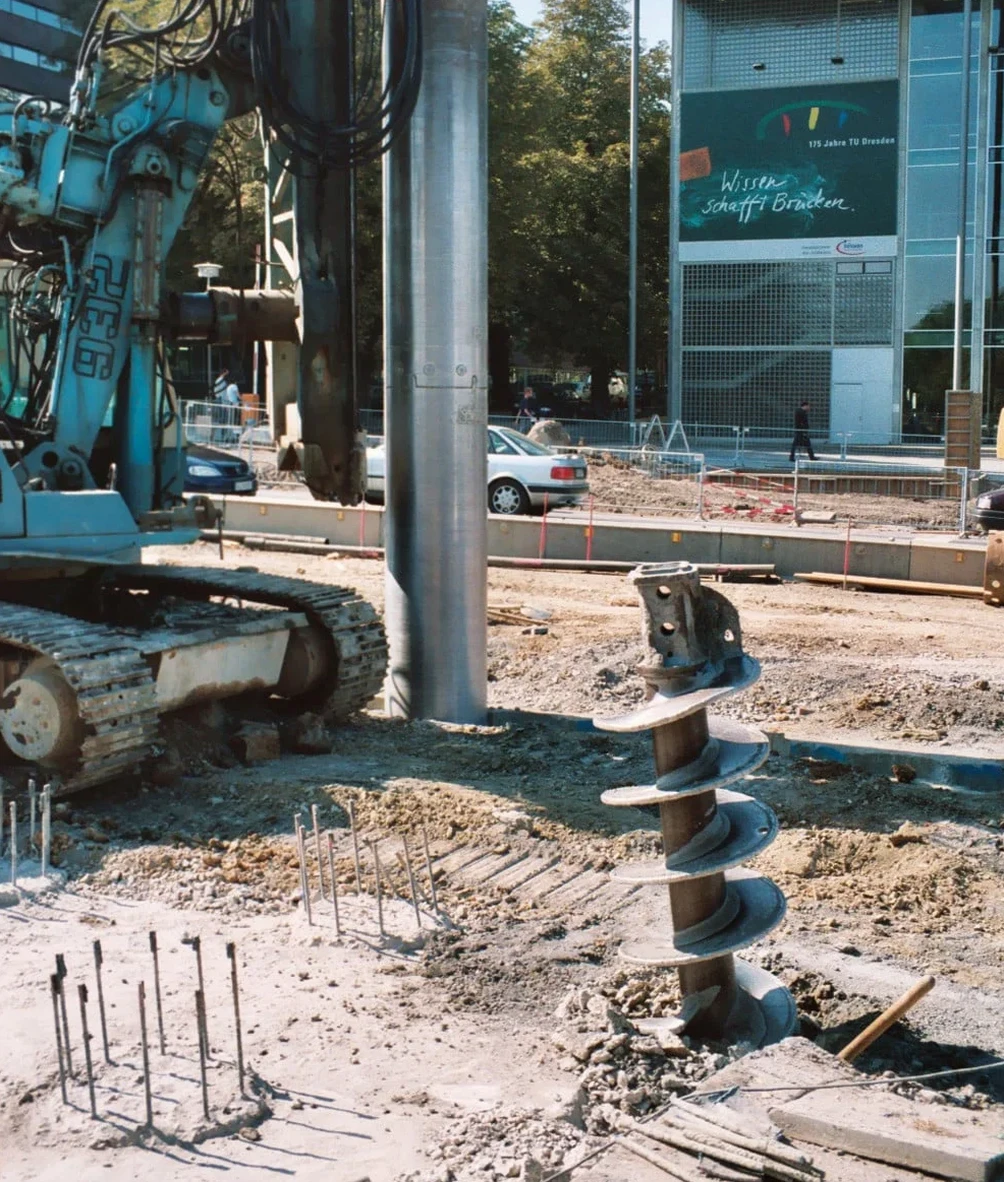
A 30-tonne crane lowers the casing into the bore while the crew monitors torque and flush return. In Brisbane's inner suburbs, where underground services from the 1960s crisscross the streets, one misplaced pile can rupture a water main or sever a fibre-optic cable. That is why we overlay every pile layout on the Dial Before You Dig plans and adjust the design to avoid buried infrastructure. The bigger risk is encountering a void or old fill pocket that the desktop study missed. When that happens, we switch to a continuous flight auger rig and install temporary casing to prevent collapse. The team on site logs every 0.5 m of penetration and records the hammer energy to correlate with the design assumptions.
This service complements our laboratory testing work for a complete project analysis.
Typical values
Parameter
Typical value
Pile type
Bored, driven, CFA, screw
Design standard
AS 2159:2009
Load test method
Static (maintained load) per AS 1289
Shaft friction range
30 – 120 kPa (site-dependent)
End-bearing capacity
2 – 10 MPa in rock, 0.5 – 2 MPa in soil
Settlement limit
15 mm under service load (typical)
Linked services
01
Bored Pile Design
For sites with overhead restrictions or tight access, we design bored piles from 300 mm to 1200 mm diameter. We calculate shaft resistance using beta and alpha methods calibrated to Brisbane clays and rock.
02
Driven Pile Design
When sand layers or stiff clays require displacement, we specify precast or steel driven piles. Our designs include driveability analysis and wave equation modelling to prevent refusal or damage during installation.
03
Pile Load Testing and Verification
We supervise static load tests to 1.5 times the design load and interpret the load–settlement curve to confirm the geotechnical capacity. Instrumented piles with strain gauges provide shaft and base resistance distribution.
Standards used
AS 2159:2009 Piling — Design and Installation, AS 1726:2017 Geotechnical Site Investigations, AS 1289/D1143M-20 Standard Test Methods for Deep Foundations Under Static Axial Compressive Load, IBC 2021 Chapter 18 — Soils and Foundations
Frequently asked questions
What is the typical cost range for pile foundation design in Brisbane?
The cost for pile foundation design in Brisbane typically ranges between AU$2.910 and AU$9.800 depending on the number of piles, site access, and testing requirements. This includes the geotechnical interpretation, structural design calculations, and a design report suitable for council approval.
How deep do piles need to be for a house in Brisbane?
Depths vary widely. In the western suburbs where rock is shallow, piles might stop at 4–6 metres. In low-lying areas like Oxley or Rocklea, where soft alluvium extends deeper, we often go 12–18 metres to reach competent bearing strata. A site investigation is the only way to determine the exact depth.
What is the difference between end-bearing and friction piles?
End-bearing piles transfer load directly to a strong layer such as rock or dense sand. Friction piles rely on the shear resistance along the shaft to carry the load. In Brisbane, many designs combine both mechanisms — the shaft works in friction through the upper clay layers, and the tip bears on the underlying rock or weathered tuff.
Do I need a pile design for a small extension in Brisbane?
It depends on the soil. If the extension sits on reactive clay or fill deeper than 1 metre, strip footings may not provide adequate support. We have designed single-pile solutions for rear decks and small additions where the existing house was already on piles. A quick borehole or test pit will tell you whether piles are necessary.