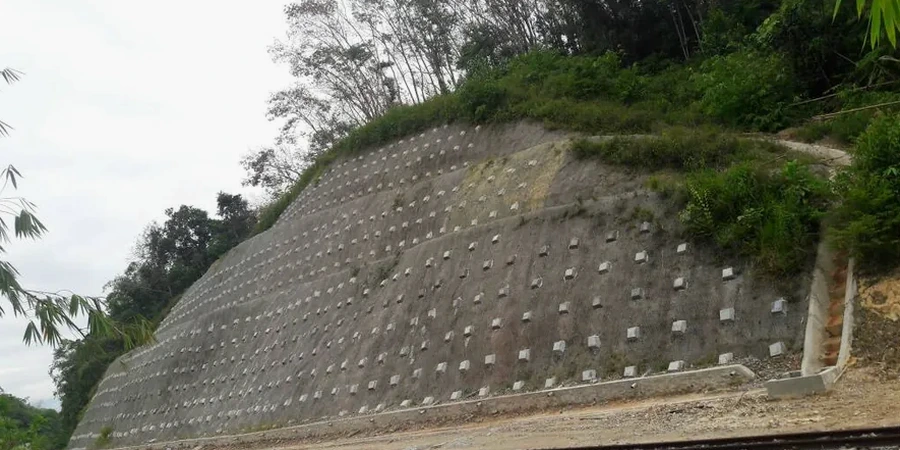
Brisbane sits on a mix of residual sandstone, claystone, and alluvial floodplain deposits, with over 300 mm of rain falling in the wettest quarter alone. That combination, plus the undulating topography of suburbs like Kenmore and Chapel Hill, makes slope stabilization design a non-negotiable step for any cut or fill. In our experience, the key is understanding how water interacts with the local soils. Before we model a slope, we often run a plate load test to calibrate the stiffness parameters, and we use MASW-Vs30 surveys to profile the bedrock interface without drilling every meter.
In Brisbane, a single lot can transition from residual clay to weathered sandstone to colluvial fill within 20 meters — uniform soil assumptions rarely hold.
Scope of work
One mistake we see repeatedly is assuming a uniform soil profile across a site. In Brisbane, a single lot can transition from residual clay to weathered sandstone to colluvial fill within 20 meters. When you ignore that variability, the slope stabilization design fails to account for weak seams or perched water tables. At a recent project in Eight Mile Plains, we uncovered a buried drainage line that had softened the entire toe of the slope. That is why we always combine a thorough site walkover with targeted sampling. For fill slopes, we recommend stabilization with lime and cement to improve the shear strength before final grading.
Technical reference image — Brisbane
Area-specific notes
AS 4678 sets the bar for earth-retaining structures, and in Brisbane that code is especially relevant because of the city’s high seasonal rainfall and reactive clay zones. A slope that works in winter can fail in summer if the drainage system is undersized. Our slope stabilization design always includes a full seepage analysis, and we cross-check the results against the N-SPT data from your boreholes. We have seen too many developers skip that step and end up with a slip surface that extends behind their proposed wall.
We build 2D and 3D limit-equilibrium models using the actual strength parameters from your site. The output includes critical slip surfaces, factor of safety contours, and a clear recommendation for reinforcement type — whether that is soil nails, anchored walls, or geogrid-reinforced fills.
02
Drainage and Surface Water Control Design
A good slope design fails without proper drainage. We design subsurface drains, diversion swales, and erosion control blankets tailored to Brisbane’s rainfall intensity. The goal is to keep the phreatic surface at least 1.5 m below the critical slip zone.
Standards used
AS 4678:2002 Earth-retaining structures, AS 1726:2017 Geotechnical site investigations, FHWA-NHI-05-077 (Soil Nail Walls – Reference Guide)
Frequently asked questions
What is the difference between a global factor of safety and a local factor of safety in slope stabilization design?
The global factor of safety (FoS) applies to the entire potential failure surface and is the standard check in limit-equilibrium analysis. The local FoS looks at individual slices or elements and helps identify weak zones within the slope. In Brisbane, where erratic hard layers and soft clay lenses are common, the local FoS often reveals a problem that the global number hides.
How much does slope stabilization design cost in Brisbane?
For a typical residential or commercial slope up to 8 m high, the design and investigation package ranges between AU$2.280 and AU$10.640. The variation depends on the number of boreholes, laboratory tests required, and whether you need a full drainage layout. Contact us for a quote tailored to your site.
What site investigation is needed before slope stabilization design?
We recommend at least three boreholes per slope face, with N-SPT measurements every 1.5 m, plus undisturbed tube samples for triaxial and direct shear testing. A groundwater monitoring well should be installed for at least one wet season. For deep-seated failures, add a MASW or refraction survey to map the bedrock profile.
Can slope stabilization design be done after construction starts?
It is technically possible but risky. Once excavation begins, the stress relief can trigger movement before you have the parameters to design a solution. We strongly recommend completing the investigation and design before any cut exceeds 2 m depth. Retrofit designs are more expensive and often require temporary shoring that could have been avoided.