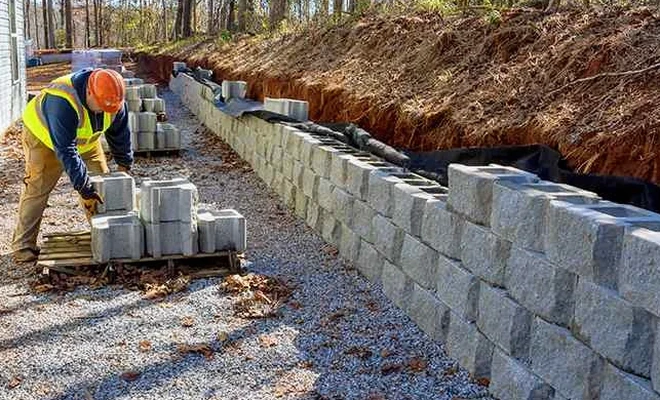
Many builders in Brisbane assume a standard gravity wall will hold back any fill. They order blocks, pour a footing and hope for the best. Then the first heavy summer storm saturates the ground behind the wall. Water pressure builds up, the drainage layer was never installed correctly, and within months the wall starts bulging. A proper retaining wall design should start with a geotechnical investigation that measures soil strength, identifies reactive clays and calculates active earth pressure. Without those numbers you are gambling with a structure that can cost more to repair than to build correctly the first time. Before pouring concrete we recommend a plate load test to verify the bearing capacity of the founding layer directly on site.
A retaining wall that ignores shrink-swell behaviour in Brisbane's reactive clays will crack within one dry-wet cycle, often before the final inspection.
Scope of work
Brisbane sits on a mix of highly reactive black soils, residual sandstone profiles and alluvial deposits along the river. The seasonal moisture changes in these soils can cause vertical movements of 50 mm or more. A retaining wall design that ignores shrink-swell behaviour will crack within one dry-wet cycle. We follow AS 4678-2002 to classify the wall type and determine the appropriate surcharge, drained and undrained conditions. The analysis includes the following parameters:
Active and passive earth pressure coefficients (Rankine or Coulomb)
Surcharge from traffic, equipment or adjacent footings
Water table position and drainage requirements
Sliding, overturning and bearing capacity checks
For walls higher than 1.5 m we also incorporate a seismic check per AS 1170.4 because Brisbane is in a moderate earthquake zone. Coupling this with a site classification via MASW gives us the shear wave velocity profile needed for dynamic analysis.
Technical reference image — Brisbane
Area-specific notes
A housing development in the suburb of Eight Mile Plains taught us a hard lesson. The contractor built a 2.4 m high cantilever wall without a subsurface investigation. The soil looked like stiff clay on the surface. Three months later the wall rotated 150 mm at the top after a wet season. Water had softened the clay below the footing and the wall had no drainage blanket. The client had to demolish the wall, install deep soldier piles and rebuild at double the original cost. A proper retaining wall design with a site-specific soil test would have identified the low shear strength and the need for a reinforced concrete stem with a proper weephole system. That is why we always insist on a full geotechnical report before signing off on any wall design in Brisbane.
Design for walls up to 6 m using stem and base slab. Includes sliding, overturning and bearing capacity checks per AS 4678.
02
Gravity walls (masonry or mass concrete)
Analysis of trapezoidal sections with passive resistance at the toe. Suitable for walls up to 2.5 m in stable ground.
03
Reinforced soil walls (MSE walls)
Design with geogrid or steel strips for walls up to 10 m. Internal and external stability verified with tie-break analysis.
04
Waterfront and flood-prone walls
Hydrostatic pressure and scour analysis for walls along the Brisbane River or in flood-prone areas. Drainage and filter design included.
Standards used
AS 4678-2002: Earth-retaining structures, AS 1726-2017: Geotechnical site investigations, AS/NZS 1170.4:2007: Structural design actions – Earthquake actions, AASHTO LRFD Bridge Design Specifications (Section 11)
Frequently asked questions
What is the difference between a gravity wall and a cantilever wall?
A gravity wall relies on its own weight to resist overturning, so it needs a wide base and is typically limited to 2.5 m height. A cantilever wall uses a reinforced concrete stem and base slab, with the soil above the heel adding resistance. Cantilever walls can reach 6 m and are common in Brisbane subdivisions where space is tight.
How much does a retaining wall design cost in Brisbane?
The geotechnical investigation and design fee typically ranges between AU$1,650 and AU$6,470 depending on wall height, site access and the number of soil tests required. A simple 1.5 m wall on a flat block will be at the lower end; a 4 m wall on a reactive clay slope will be at the higher end.
Do I need a geotechnical report for a retaining wall under 1 m?
AS 4678 does not require a geotechnical report for walls under 1 m unless they support a surcharge or are in a reactive soil area. In Brisbane, many suburbs have highly reactive clays (CH) that can cause differential movement even on low walls. We recommend a simple site classification test to avoid cracking.
What drainage is required behind a retaining wall?
AS 4678 specifies a 300 mm wide drainage layer of free-draining aggregate behind the wall, with a perforated pipe at the base connected to a positive outlet. Without that, hydrostatic pressure can exceed the design load and push the wall over. We always include drainage design and weep hole spacing in our reports.