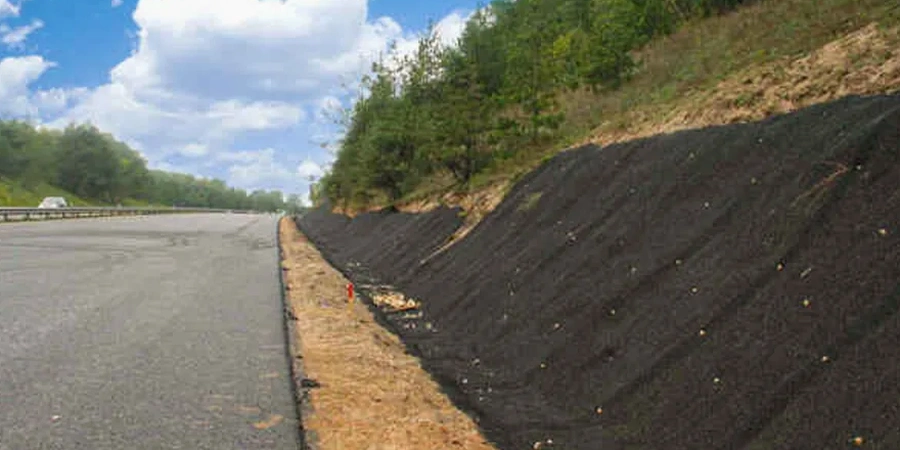
With over 2.5 million people and sprawling suburban growth, Brisbane demands embankment designs that handle both the weight of fill and the seasonal soaking from summer storms exceeding 1,200 mm annually. Our team approaches each road embankment design by first correlating the local soil profile — often a mix of residual clays and alluvial deposits — with the proposed loading. Before we run any stability model, we verify the subgrade conditions through a granulometry test to classify fines content and a density cone sand test to establish in-situ compaction. That baseline lets us tailor the fill material and lift thickness to Brisbane's specific moisture regime, avoiding the differential settlements that plague projects built on old river terraces.
In Brisbane's residual clays, a CBR drop from 12 % to 3 % after one wet season is common — drainage design must precede fill placement.
Scope of work
Brisbane's geology transitions from Neranleigh-Fernvale metasediments in the west to Quaternary alluvium along the Brisbane River, so our road embankment design adapts to each zone. We typically encounter stiff to hard clays with SPT N-values of 15–30 in the western suburbs, while the eastern corridor shows soft alluvial clays with N-values below 8 that require staged construction. A key parameter we measure is the California Bearing Ratio (CBR), which in Brisbane's residual soils can range from 3 % in wet conditions to 15 % when properly compacted. We also apply the plate load test directly on the prepared formation to confirm modulus of subgrade reaction before placing the first lift. This combination of index tests and in-situ verification gives us the confidence to specify fill placement rates that prevent pore-pressure buildup during wet-season construction.
Technical reference image — Brisbane
Area-specific notes
Brisbane's rapid suburban expansion since the 1990s pushed road corridors onto former floodplains and reclaimed lowlands. Many older embankments along the Gateway Motorway and Ipswich Motorway were built without deep drainage, leading to internal erosion and slumping after the 2011 flood event. That history taught us that a road embankment design in Brisbane must incorporate horizontal drainage blankets and toe drains from day one, especially when the fill height exceeds 4 m over soft alluvium. Ignoring the perched water table that appears after three consecutive rain days is the fastest way to rebuild a failed slope.
Boreholes and test pits to classify soil strata, measure groundwater levels, and obtain undisturbed samples for laboratory testing, all to AS 1726 standards.
02
Compaction Control and CBR Testing
Field density tests (nuclear gauge and sand cone) plus soaked CBR at 98 % MDD to verify that each lift meets the specified strength for the embankment design.
03
Slope Stability Analysis
Limit-equilibrium and finite-element modeling using Bishop and Morgenstern-Price methods to assess factor of safety under both static and seismic loading per AS 4678.
04
Settlement Monitoring and Instrumentation
Installation of settlement plates, inclinometers, and piezometers to track consolidation rates and pore-pressure dissipation during staged construction.
Standards used
AS 4678-2002 (Earth-retaining structures – relevant to embankment stability), AS 1289.6.1.1 (Determination of the California Bearing Ratio of a soil), AUSTROADS Guide to Pavement Technology Part 2 (Pavement Structural Design), AS 1726-2017 (Geotechnical site investigations)
Frequently asked questions
What is the typical CBR value required for embankment fill in Brisbane?
For major road projects, Brisbane City Council generally requires a soaked CBR of at least 5 % at 98 % of maximum dry density. In the western suburbs where residual clays are common, we often achieve 10–15 % with proper moisture conditioning, but the design must account for the drop after prolonged wet weather.
How does the water table affect embankment design in Brisbane's alluvial zones?
The seasonal water table along the Brisbane River and in areas like Eight Mile Plains can rise within 1 m of the surface after heavy rain. If not captured by a subsoil drainage system, this perched water reduces effective stress and can trigger rotational failures. Our designs always include a drainage blanket and toe drains when the fill exceeds 3 m over alluvium.
What is the typical cost range for a road embankment design study in Brisbane?
For a standard two-lane road embankment up to 6 m high on a 200 m corridor, the geotechnical investigation and design package typically ranges between AU$2.060 and AU$7.360. The final figure depends on the number of boreholes, laboratory tests required, and whether slope stability modeling is needed for steep fills.
Can I use on-site fill material for the embankment, or do I need imported material?
Brisbane's residual clays can be used as structural fill if they are moisture-conditioned to within 2 % of optimum and compacted to 98 % MDD. However, if the material has a plasticity index above 35 % or contains significant organic matter, it is unsuitable and must be replaced with imported granular fill. A preliminary Atterberg limits test and organic content analysis will tell you which path to take.