Brisbane expanded rapidly after the 1974 floods, pushing new subdivisions onto former floodplains and alluvial terraces. Many existing pavements in suburbs like Indooroopilly or Chermside now sit on variable fill or soft clay layers that were never properly compacted. Evaluating those pavements before any overlay or reconstruction is the only way to avoid premature failure. We combine core sampling, dynamic cone penetrometer testing and in-situ moisture measurement to produce a reliable structural number for each section. Before any overlay we also recommend checking the subgrade with a plate load test to confirm the design modulus, and a CBR evaluation where the base course shows signs of moisture damage.
Without a proper evaluation, overlaying a pavement on reactive clay in Brisbane is a gamble—cracks can reappear within two wet seasons.
Scope of work
Brisbane sits at an average elevation of just 30 m above sea level, with a subtropical climate that delivers over 1,000 mm of rain annually. That combination creates a unique challenge: high seasonal moisture variation in the subgrade, especially on reactive clay sites. Our evaluation covers:
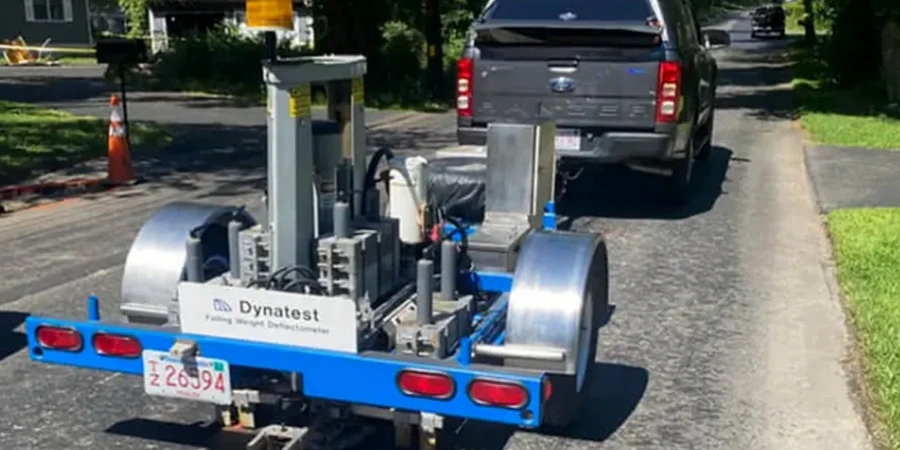
Falling weight deflectometer (FWD) testing for deflection basins
Pavement coring and layer thickness verification
In-situ California Bearing Ratio (CBR) on untreated subgrades
The output is a treatment recommendation—whether partial mill-and-replace, full reconstruction or a structural overlay—tailored to Brisbane’s wet-dry cycle. We also identify weak spots that could cause differential settlement in future.
Technical reference image — Brisbane
Area-specific notes
A shopping centre access road in Cannon Hill showed alligator cracking within 6 months of a thin asphalt overlay. The original evaluation had missed a deep clay pocket left from an old creek diversion. We cored through the failed area and found the base course saturated at 22% moisture—double the optimum. The fix required full-depth removal and replacement with a cement-treated base. That job would have been avoided with a proper existing pavement evaluation covering the whole alignment, not just the visible surface.
Full distress mapping plus 4–6 cores per 100 m of pavement. Each core logged for layer thickness, material type and condition. DCP testing at each core location to estimate in-situ CBR. Recommended for preliminary assessments or low-traffic roads.
02
FWD & Structural Analysis
Falling weight deflectometer testing at 20 m intervals, back-calculation of layer moduli and remaining life prediction. Includes a treatment report with overlay thickness or reconstruction depth. Suited for arterial roads, airport aprons and heavy-vehicle pavements.
Standards used
AS 1726 – Geotechnical site investigations, Austroads Guide to Pavement Technology Part 2: Pavement Structural Design, AS 1289.2.1.1 – Soil moisture content determination
Frequently asked questions
How long does an existing pavement evaluation take in Brisbane?
A standard evaluation for a 1 km road section takes 3 to 5 days including field testing, core transport and laboratory analysis. FWD testing can be completed in a single shift if traffic management is arranged in advance.
Do you need traffic control for the testing?
Yes, for FWD and coring on open roads. We coordinate with Brisbane City Council traffic management requirements and can arrange lane closures or stop-slow operations. On private sites like car parks, no traffic control is needed.
What is the typical cost range for an existing pavement evaluation?
For a typical 1 km suburban road, costs range from AU$1.660 to AU$6.080 depending on the number of cores, whether FWD is included, and the level of laboratory testing. We provide a fixed quote after reviewing the site scope.
Can you evaluate pavements built before the 1974 Brisbane flood?
Absolutely. Many pre-1974 pavements in Brisbane used unbound gravel bases and thin bitumen seals. We adjust the evaluation method to account for older materials—using larger cores and extended DCP penetration to reach the original subgrade. This is critical for roads in low-lying suburbs like Milton or New Farm.