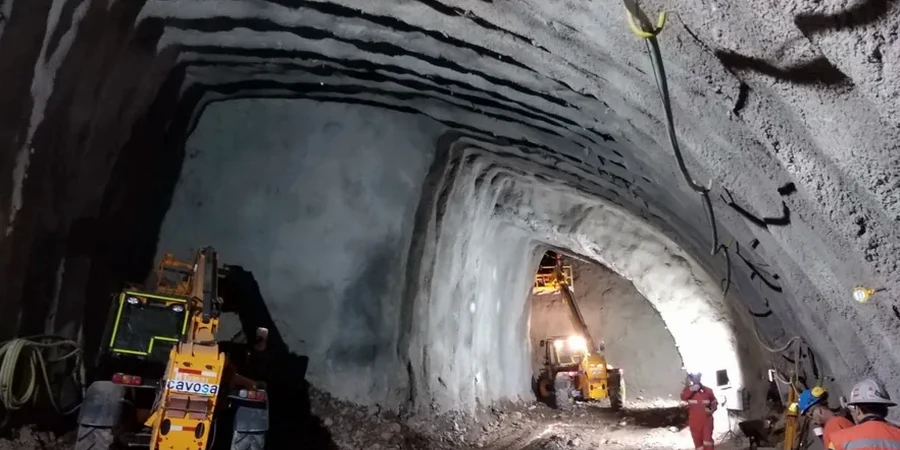
We were called to a site in Eight Mile Plains where a 4.5-meter-diameter stormwater tunnel was about to cross a buried creek channel. The bore logs from the preliminary investigation showed soft alluvial clays extending 14 meters below the invert. If we had relied only on those logs and skipped detailed softening parameters, the tunnel face could have collapsed during excavation. That job taught us something we now apply to every tunnel project in Brisbane: soft soils here don't behave like textbook deposits. The high moisture content in the floodplain sediments, combined with tidal groundwater fluctuations in the Brisbane River corridor, means undrained shear strength can drop by half within one rainy season. We design our geotechnical analysis for soft soil tunnels specifically to capture these transient conditions, using both In-Situ and advanced laboratory triaxial work. We also cross-check against monitoreo de excavaciones data from nearby sites to calibrate our models.
In Brisbane's soft alluvial deposits, undrained shear strength can drop by half within a single wet season if transient pore pressures are ignored.
Scope of work
Our approach follows AS 1726-2017 for subsurface investigation and AS 4678-2002 for earth-retaining structures. For Brisbane's soft soil tunnels, the critical parameters are undrained shear strength, coefficient of consolidation, and the stiffness degradation curve at small strains. We use a combination of:
Borehole SPT with Shelby tube sampling for intact specimens
Triaxial testing (CIUC and CK0UC) on undisturbed samples
Oedometer testing with pore pressure measurement
MASW geophysics to map stiffness contrasts across the tunnel alignment
In our experience, the asentamiento diferencial risk is highest where the tunnel transitions from deep rock to soft soil, which happens under the CBD near the river. We also run ensayo triaxial cyclic tests to evaluate strength loss under construction vibrations. Each parameter feeds into a 2D or 3D finite element model that simulates excavation sequences and predicts surface settlements.
Technical reference image — Brisbane
Area-specific notes
The geology under Brisbane is deceptive. You can have stiff desiccated crust at the surface, then 8 to 15 meters of soft Holocene clay with interbedded sand lenses that act as drainage paths. The water table sits at 1.5 to 3 meters depth across most of the inner suburbs. If you drive a tunnel through these sands, you get immediate water inflow and loss of effective stress. We saw this happen on a sewer tunnel in Woolloongabba — the face collapsed 7 meters before they could install the first liner ring. That is why our geotechnical analysis for soft soil tunnels always includes dissipation tests during CPTU to measure pore pressure response in real time. Without that data, any numerical model is just a guess.
We design and supervise a site investigation program along the proposed tunnel alignment, including boreholes, CPTUs, geophysical surveys, and laboratory testing. Deliverables include a ground model with stratigraphy, groundwater conditions, and geotechnical parameters for design. We also provide face stability analysis and settlement predictions using advanced numerical methods.
02
Long-Term Tunnel Performance Monitoring
After construction, we continue monitoring pore pressures, surface settlements, and liner loads using vibrating wire piezometers, inclinometers, and settlement plates. This data validates the design assumptions and helps us refine the geotechnical analysis for soft soil tunnels on future projects. Our monitoring reports are compliant with AS 1726 and the project specifications.
Standards used
AS 1726-2017 (Geotechnical site investigations), AS 4678-2002 (Earth-retaining structures), AS 1289.6.4.2 (Consolidated undrained triaxial test), NCEER 1997 (SPT-based liquefaction evaluation)
Frequently asked questions
What is the difference between undrained and drained analysis for soft soil tunnels?
Undrained analysis applies when loading is fast relative to drainage — typical during tunnel excavation in low-permeability clays. Drained analysis applies when the soil can dissipate pore pressure during construction, which happens in sands or silts. For Brisbane's soft clays with permeability around 1x10⁻⁹ m/s, we almost always use undrained parameters for short-term stability and drained parameters for long-term settlement.
How do you handle groundwater in the tunnel face stability calculation?
We measure in-situ pore pressure with piezometers installed in the boreholes and during CPTU dissipation tests. The water table in Brisbane typically fluctuates 1 to 2 meters seasonally due to tidal influence near the river. We incorporate this range into our face stability models using the effective stress method described in the FHWA manual and calibrated with local case histories.
What is the typical cost range for a geotechnical analysis for soft soil tunnels in Brisbane?
For a typical tunnel project in Brisbane, the cost ranges between AU$7,230 and AU$26,970 depending on the number of boreholes, testing complexity, and the length of the alignment. A preliminary assessment with 5 boreholes and basic lab work falls at the lower end, while a full investigation with CPTUs, triaxial testing, and numerical modeling reaches the upper end. Contact us for a project-specific quote.
Can you use existing borehole data from nearby sites?
Yes, we always review existing data from the Queensland Government's borehole database and previous projects in the area. However, soft soil conditions can vary significantly over short distances — we have seen 5-meter changes in clay thickness between boreholes 50 meters apart. We supplement existing data with at least 2 new boreholes per tunnel drive to confirm variability.
How long does a geotechnical analysis for a soft soil tunnel take?
A typical investigation takes 6 to 10 weeks from start to final report. The first 2 weeks cover desktop study and site planning, 3 to 4 weeks for field work (drilling, CPTU, sampling), and 3 to 4 weeks for lab testing and reporting. If you need faster turnaround, we can prioritize the critical boreholes and deliver a preliminary ground model in 4 weeks.