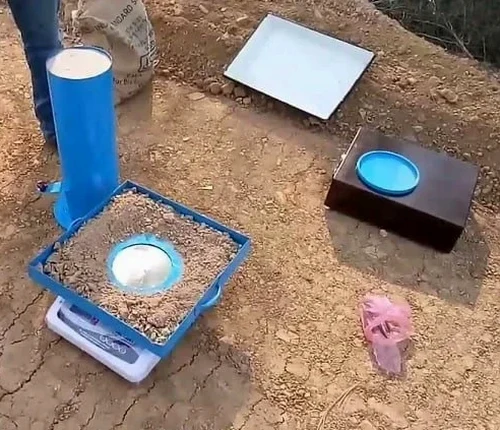
Brisbane’s subtropical climate, with annual rainfall exceeding 1,100 mm, creates persistent moisture challenges for earthworks. The city’s weathered phyllites and clay-rich residual soils can shift density rapidly after rain, making timely field verification essential. Our sand cone test delivers in-situ dry density and moisture content on site, following AS 1289.5.3.1. This method is particularly effective for granular fills and cohesive subgrades common in Brisbane’s expanding housing estates. Combining it with a plate load test before pavement placement ensures the design modulus matches the compacted density, avoiding costly remedial work later.
In Brisbane’s reactive clays, a single sand cone reading can prevent pavement failure that would cost ten times the test itself.
Scope of work
A recent subdivision project in Springfield Lakes required compaction control across 8,000 m³ of engineered fill. We carried out sand cone tests at 25 locations per lot, correlating results with the project’s Proctor curve. The procedure involves excavating a small test hole, weighing the removed material, and filling the hole with calibrated sand from a cone apparatus. Key steps we follow in Brisbane:
Calibrate sand density in the lab before field deployment.
Excavate a 100–150 mm diameter hole, carefully collecting all material.
Determine moisture content via oven-drying or speedy moisture meter.
These tests also help validate the effectiveness of stabilization with lime and cement when treating expansive clays found across the Ipswich corridor.
Technical reference image — Brisbane
Area-specific notes
In Brisbane, many contractors overlook the moisture sensitivity of the local phyllite-derived fills. If the sand cone test is performed too soon after rain, the measured density can appear artificially high because of pore water occupying void space. Conversely, testing during the dry winter months may yield low moisture readings that mask inadequate compaction. The real risk lies in relying on a single point per layer without statistical coverage. We recommend at least one field density test per 250 m² of compacted area, especially on projects near the Brisbane River where alluvial lenses create variable conditions.
In-situ density and moisture content for fine to medium-grained soils. Suitable for road subgrades, trench backfill, and embankment layers. Results reported within 24 hours.
02
Nuclear Gauge Correlation
When speed is critical for large-volume fill, we correlate nuclear gauge readings with sand cone results on the same material. This provides rapid QC while maintaining AS 1289 traceability.
03
Moisture-Density Profile
Multiple sand cone tests at varying depths to assess compaction uniformity across lift thickness. Essential for deep fills in developments like North Lakes or Ripley Valley.
Standards used
AS 1289.5.3.1 — Determination of field density and moisture content using the sand replacement method, AS 1289.5.4.1 — Compaction control test (Hilf method), TMR Q142 — Queensland Department of Transport and Main Roads field density test procedure
Frequently asked questions
What is the sand cone method used for in Brisbane?
It measures the in-situ dry density and moisture content of compacted soil, verifying that earthworks meet the project's specified compaction requirements per AS 1289.
How much does a field density test cost in Brisbane?
Typical rates range between AU$140 and AU$240 per test point, depending on site access, number of tests, and reporting format. Bulk discounts apply for projects requiring 20+ tests.
Can the sand cone test be used on gravelly fills?
Yes, but the maximum particle size must not exceed 50 mm. Larger aggregates require a larger test hole or alternative methods such as the rubber balloon or nuclear gauge.
How long does it take to get results?
Field readings are completed within 20 minutes per test. Full laboratory moisture content and dry density calculations are typically reported within 24 hours of sample collection.
What standards govern field density testing in Queensland?
The primary standard is AS 1289.5.3.1. Transport and Main Roads (TMR) also mandates supplementary procedures under Q142 for state-funded road projects in Brisbane.